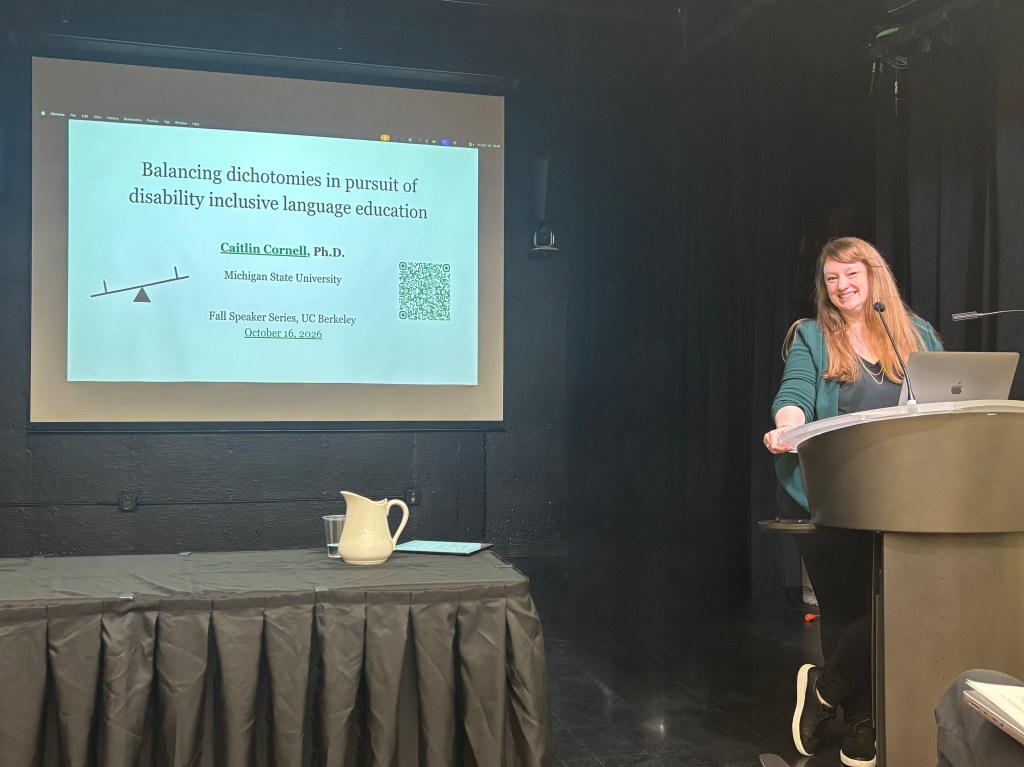
October 16, 2026 – I had a fabulous time speaking to language educators at Berkeley. I’m so grateful to the Berkeley Language Center for the invitation to speak in their fall speaker series about disability inclusion for language education.
My abstract: Enacting disability inclusion in educational contexts can feel like being pulled in multiple directions, attending to several dichotomies simultaneously. Two things can be true at once: disability inclusion can be both concrete and abstract; acute and habitual; proactive and reactive. In this talk, we’ll discuss dichotomies that persist at various levels of institutional operations across university structures: institution-wide, departmental, and in the classroom. Institutions must adhere–quite urgently–to federally mandated digital accessibility compliance. At the same time, higher education must not squander the opportunity to strategize toward establishing a robust institutional culture that can sustain broader inclusive practices long term. Disability inclusion, while worthy of effort for its own sake, takes on a flavor of urgency for language program administrators who understand that disability inclusion also plays a critical role in recruitment and retention in this time of declining enrollments. For language educators, pursuing disability inclusive practices in the classroom means finding a complementary balance between best practices in language pedagogy and accessible and flexible opportunities for learning.